
BUYING AN ESTABLISHED VINEYARD A CASE STUDY
The following is a case study from The Rural Diversification Collective.
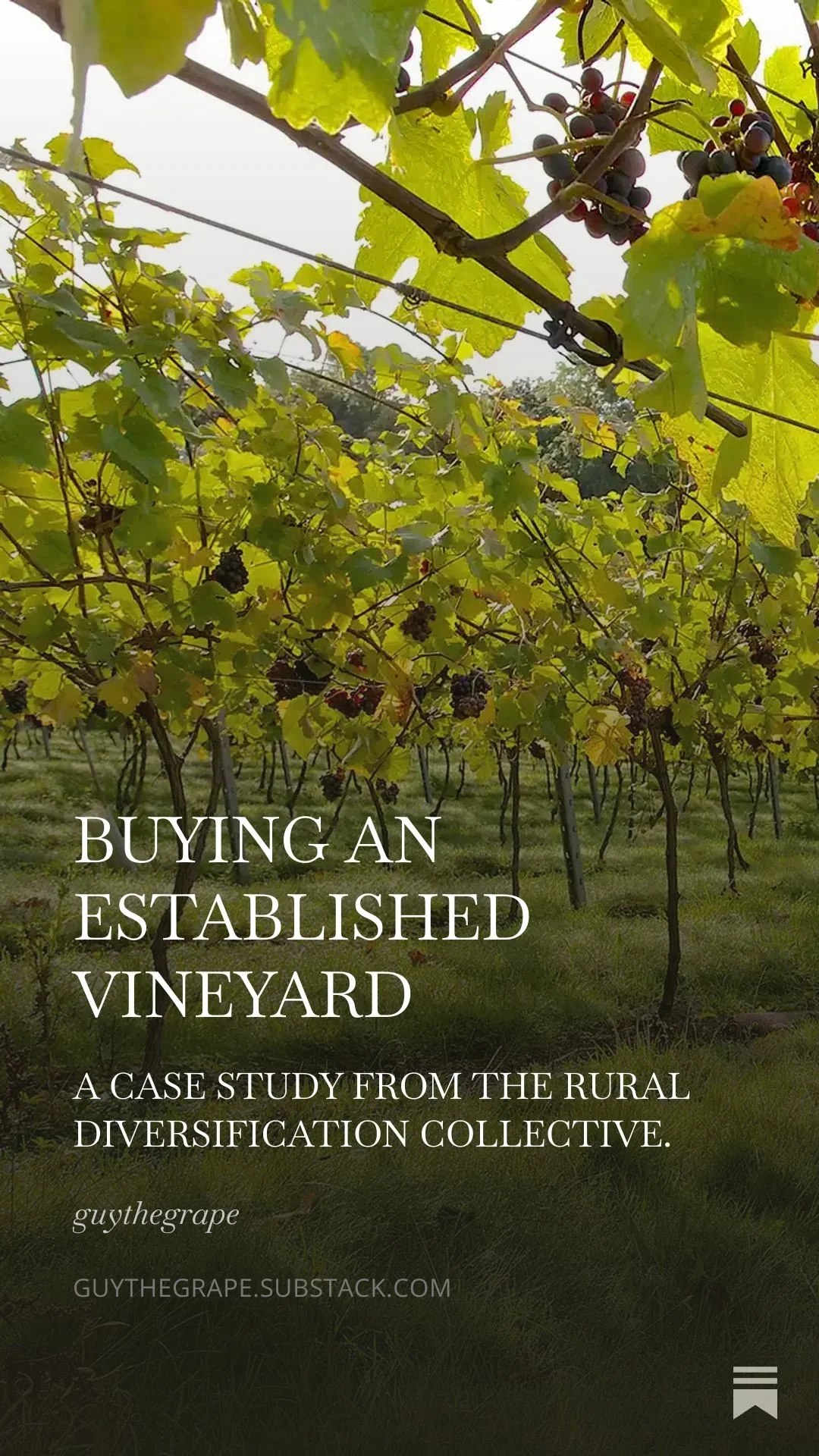
There’s a world of difference between starting a vineyard and stepping into one that already delivers. Most opportunities require years of planning, planting and waiting for returns. Smith and Evans offers something far more compelling: an established, proven English wine business with product, market presence and operational systems already in place. For a buyer, that means reduced risk, immediate traction and the ability to build on an existing success rather than starting from zero.
21 April 2026
Smith & Evans
Higher Plot Farm, Aller Road, Langport TAIO OQL
A vineyard built over time, with diversification foundations already in place
There is a clear distinction between starting a vineyard and stepping into one that already works. Most opportunities sit firmly in the former category. Land, buildings, and a set of assumptions about what might be possible. For those exploring rural diversification, this difference is critical.
Smith and Evans at Higher Plot Farm offers the latter. This is not a newly planted site or an early-stage venture. It is an established English wine operation, built over nearly two decades, with a proven product, a recognised route to market and a model that has already been tested under real conditions.
That distinction matters more now than it did even five years ago. Interest in English wine continues to grow, but so does the complexity of entering the market. Site selection, planting, production and commercialisation all take time, particularly when approached as part of a broader farm diversification strategy. Returns take longer. For most, it is a process measured in years rather than seasons. Here, that process has already been worked through.
We met Guy Smith at a point where the emphasis is no longer on building, but on what follows for Higher Plot Farm and for Guy personally. As he explains, the vineyard itself was not an opportunistic purchase. Several years were spent searching for the right site before any vines went into the ground. Not simply somewhere attractive, but somewhere capable of producing consistently high quality fruit. That emphasis on site is not theoretical. The most important decision in any vineyard is location. A vineyard may look appealing, but without the right conditions it will not produce. At Higher Plot, that question has already been answered.
Planting began in 2008. The first wines followed in 2010. What exists today is the result of a long, incremental process of refinement. It is also a longer process than many expect. What begins as a five year plan often becomes eight. Today, Smith and Evans produces award winning Pinot Noir, Chardonnay and Meunier wines, with production at around five thousand bottles a year. It is a scale that allows for control, but also demands a clear understanding of how the business actually works.
“We never really set out with a fixed idea of what the wine should be,” he says. “You work with what the vineyard gives you.”
That variability is part of the appeal, but it also underlines something more practical. At this scale, success depends as much on how the wine is sold as how it is made. The wines are produced using natural fermentation, relying on wild yeasts present in the vineyard and winery rather than commercial strains. It reduces control, but allows each vintage to reflect the conditions of the year more directly, something that carries weight in the variability of the English climate.
The commercial model has evolved alongside the wine. Earlier years were more heavily weighted towards the trade, at one stage accounting for around seventy percent of sales. That has now moved closer to sixty percent, with a growing emphasis on direct sales. Trade brings reach and volume. Direct sales bring margin and control. At Higher Plot, that balance is supported by a functioning cellar door, an established online presence, and vineyard tours that bring customers onto the site in a structured way.
The practical reality of that became clear during our conversation. We paused briefly as a car pulled into the yard. A couple had arrived to buy wine. A short chat, a transaction, and then back to where we left off. It is a small moment, but a telling one. This is not a business that operates at arm’s length.
The rhythm of the year reflects that balance between production and presence. Winter is largely spent outside, often in poor conditions, doing the work that determines the next harvest. Much of it goes unseen. Summer is different. It is “Show Time”. The vines still demand attention, but so do the visitors. Tours, tastings and direct sales become part of the daily routine.
We reflect on the common assumption that farming is a solitary occupation. In practice, particularly at this scale, that is only half true. I ask Guy how easy it is to transition from farming to hospitality.
“People assume farmers won’t naturally have those hospitality skills,” he says. “But what they do have is authenticity. That matters.”
It is this shift, from working the land to engaging directly with customers, that has shaped and evolved the business. Once customers are arriving on site, the vineyard stops being simply a place of production. It becomes somewhere people actively choose to visit. Tours provide a clear entry point. They offer context, create engagement, and lead naturally into direct sales, while establishing something more valuable: a direct relationship between producer and customer.
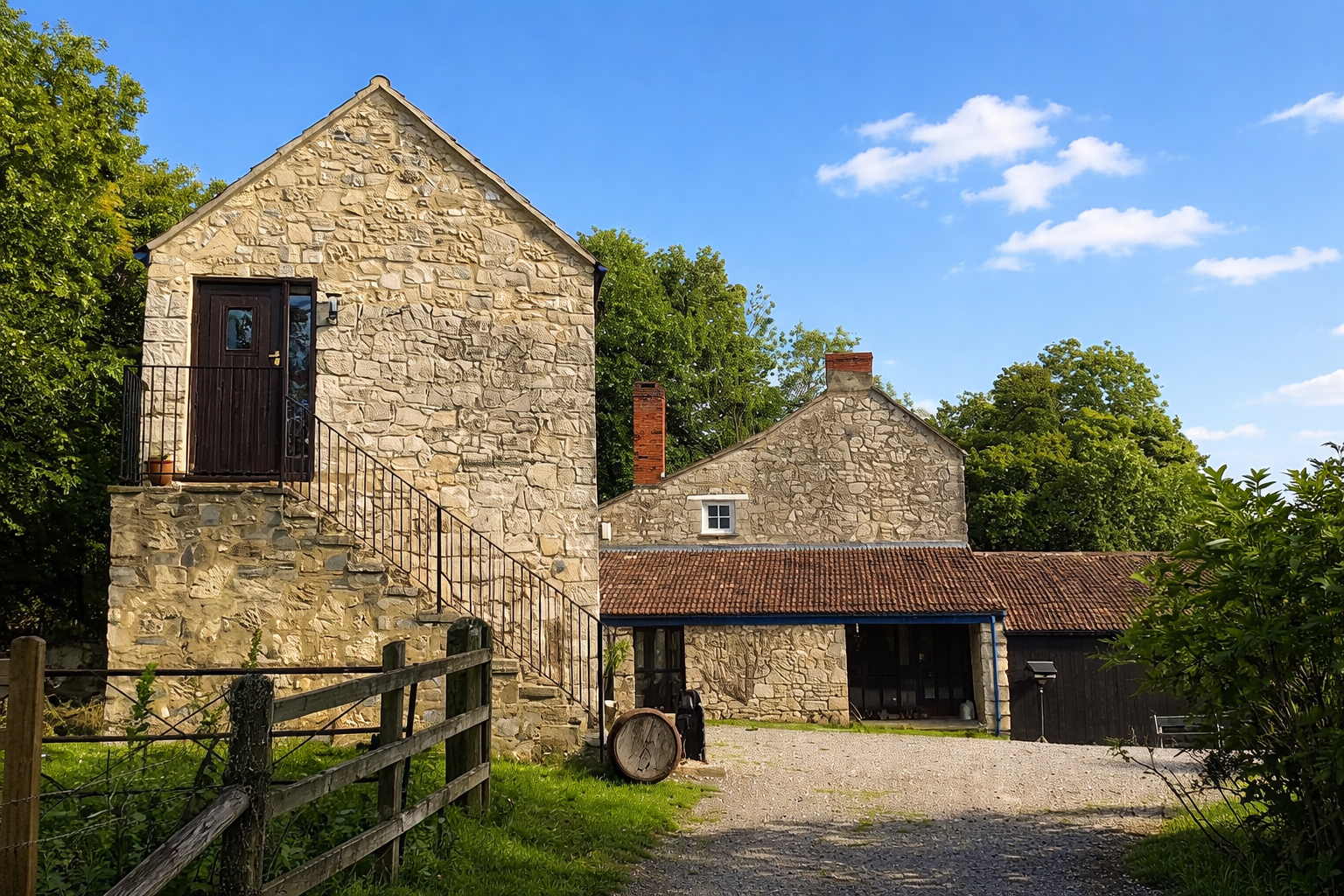
From there, the next step is straightforward. If people are willing to travel, there is a clear logic in giving them a reason to stay. The two bed barn conversion has already demonstrated that demand exists, particularly for rural accommodation within a wider farm diversification strategy. Whilst over the last year Guy and his wife have opted to retain the barn for family use, it previously operated as an Airbnb, achieving strong occupancy from spring through to early autumn.
The four-bed farmhouse offers further potential. The ground floor space lends itself to a more formalised hospitality offering, including the possibility of a restaurant or private dining. Adjacent buildings provide the operational backbone of the vineyard, but also offer flexibility for future use. There is also an additional acre where, subject to planning, further accommodation such as eco huts could be introduced, reflecting a model already proven locally.
For those considering the purchase of a vineyard, Higher Plot Farm presents a compelling opportunity from a rural diversification perspective. Direct sales are already established, but there is scope to push them further. Increasing on-site engagement strengthens both margin and customer retention. Accommodation is the most immediate lever. The demand has already been proven. Reintroducing it, and potentially expanding it, would increase revenue per visitor. There is also scope for a more formalised hospitality offering, with the farmhouse layout lending itself to restaurant or private dining use.
Higher Plot Farm is not a concept or a plan. It is a working business with a clear track record. What comes next will depend on the ambition of whoever takes it forward. Guy Smith and Laura Evans are ready for their next chapter. There is a natural symmetry here. A vineyard that has diversified and grown its direct sales is now being offered to the market in the same way. If Higher Plot Farm is of interest, Guy Smith and Laura Evans are offering the vineyard for sale directly via https://www.smithandevans.co.uk/
About Guy Smith
Before establishing the vineyard, his career was spent in the drinks industry at an international level, working with producers across Europe, Australia and New Zealand. His focus was on understanding consumer demand and translating that into commercially viable products, from concept through to route to market.
That experience covered strategy, product development, sourcing, branding and large scale distribution, including work with Winegrapes Australia, Brand Phoenix and Castel Frères, alongside building own label and branded programmes for major UK retailers.
Today, when not tending the vines and engaging with customers, Guy continues to share his perspective on the English wine industry via his Substack, guythegrape.